The God is in the Details
What God of War taught me about perfection.
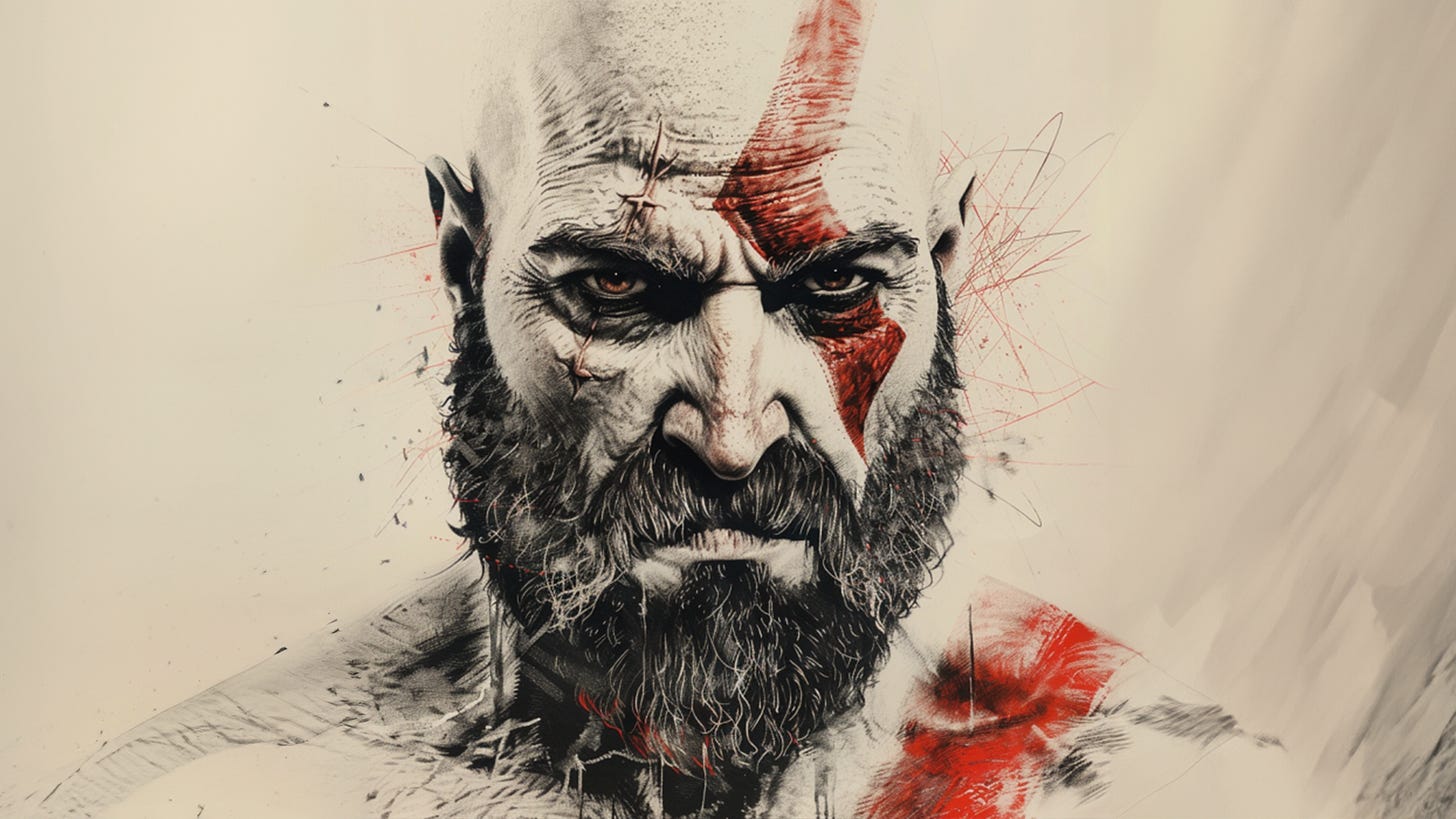
Season 3 of the Artwell podcast is available now! I studied God of War and interviewed its creators to find lessons that are relevant for modern creatives.
There’s this rhetoric that in a digital world quantity matters more than quality. That if you aim for perfection, it lowers your output which is a bad thing. This has led to the idea that “perfect isn’t perfect, good enough is perfect”. This is wrong. Good enough is not perfect. Perfect is perfect. But the thing is, perfection is unattainable. However, it is in striving for it that you can make something great. Striving for good enough, leads to you making something that is only good.
God of War is considered by many to be a prime example of video games as an artform and the reason for that is because its developers refuse to settle for good enough. Instead of aiming to maintain an annual or bi-annual release cadence, a new God of War comes out every three to five years. This is because they want to give themselves enough time to make their games as great as they possibly can be. This focus on quality over quantity has resulted in God of War being regarded as one of the greatest properties in all of gaming, boasting one of the highest franchise average metacritic scores in history.
This isn’t to say that you can’t have success making things that are good, but why settle for that? If you truly care about your art, why not spend the extra time to make it great? For your art to stand the test of time you have to make something that is both impactful on consumers and influential to your peers. You don’t get that with average. You get that with greatness.
“We want every release of God of War to be relevant in the industry and in gamers minds and memories. We don’t want to have a game come out every year, [or] couple years.” – John Palamarchuk, Lead Cinematic Artist, God of War 3, 2010
Details
In order for something to truly be great, every single piece of it must be great. The smallest of details should matter just as much as everything else. God of War Ragnarok director Eric Williams has a philosophy that all eights make a ten. What he means by that is that every single piece of the game needs to have a quality score of at least 8/10 or higher. From the totality of the story down to the design of an individual crate in a random corner of the world, everything needs to maintain the same level of quality.
The idea is that if everything is at that level, there will be nothing to detract from the experience. If people have a great time and there’s nothing that takes away from it, they will perceive your art as a masterpiece, a 10/10. Versus, if you have a mixture of tens and sixes, the sixes will detract from the experience. Even if it’s a small detail that doesn’t meet the threshold, it will stick out and lower your art’s perceived polish.
“When you're a carpenter making a beautiful chest of drawers, you’re not going to use a piece of plywood on the back, even though it faces the wall and nobody will ever see it. You'll know it's there, so you're going to use a beautiful piece of wood on the back. For you to sleep well at night, the aesthetic, the quality, has to be carried all the way through.” – Steve Jobs, Co-Founder, Apple, 1985
The argument of course, is that most people won’t ever even notice the little details… and that is absolutely true. But there’s a level of attention and care required to focus on the details that will be felt throughout the greater piece. It’s not that people will notice each and every detail, but they’ll notice the extra effort. If you create something that is great across the board, people will have a great time with it. It doesn’t matter how much or how little someone is able to articulate exactly why they enjoyed their experience. If it feels great to them, that is how they will perceive your art.
That being said, there are still people who will notice the little details and they are the ones who matter most. It is your die hard fans who will notice the little things, and when they do it will make them appreciate your art that much more. When they know that the more they put in, the more they get out, the more time they will invest. In doing that, they deepen their connection to your art, and the deeper their connection gets, the more impactful your art is on them. But the thing is, different people will notice different details which is why they all need to be great.
"‘I was rewarded for being curious’… that phrase was something I kept hammering to people." — Cory Barlog, Director, God of War, 2018
You want your art to be simple enough on the surface so that everyone can enjoy it but with enough substance underneath it for your die hard fans to dig into. By perfecting the details you take nothing away from those who don’t notice them, and give everything to the people who do.
Effort
Saying you need to focus on the details is one thing, actually doing it is another. The path to greatness is not easy. There are no shortcuts, there is only hard work. That hard work, in order for it to mean anything, must be sustained throughout the entire project. The aim is to finish on an upswing, as opposed to a down turn. You want to sprint through the finish line, and not walk across it.
Nathan Phail-Liff, the lead 3D artist on God of War: Chains of Olympus has this idea called “Artist Math”. Artist Math dictates that 90% of your effort is equal to 60% of your audience’s perception of polish. Therefore, that final 10% of effort yields an additional 40% to the final perception of polish. Meaning, you get disproportionate returns when you put in the extra effort to try and elevate something from good to great.
"You always hope that there's some cool shortcut but there never is. It's just like, 'No, spend months.'" – Cory Barlog, Director, God of War, 2019
This isn’t to say that making something good doesn’t require effort. Good enough is on the path to perfection. In fact, most of your effort will be spent trying to get to a point where your art is good enough. The challenge is that by the time you have to give the extra effort to make it great, you have almost nothing left in the tank. This is an inflection point all artists come to because at this point, it becomes tempting to settle. It is in that final 10% where the difference is made. Greatness does not come at the beginning of a project, it comes at the end.
The issue most people have is putting in extra effort and striving for perfection takes more time which means you can’t release as often. But that’s not necessarily a bad thing. God of War has released only two games in the last 10 years, and those two games have the highest rating in franchise history. Call of Duty on the other hand continues to release a new game every single year and their most recent game is the lowest rated in franchise history. If taking more time leads to you putting out less but putting out better, then it’s worth it.
Unchecked is when perfection becomes a problem. Not giving yourself enough time can be detrimental but giving yourself too much time can start to have diminishing returns. This is why deadlines are a critical part of the creative process. They prevent you from spending more time than is necessary by forcing you to prioritize what’s actually important, and focusing on the things that matter. If you’re going to put in the effort to focus on all of the details, you want to make sure that every single one has justified its existence. You don’t get close to perfect without cutting that which is unnecessary.
“There’s no limit to good ideas but there is a limit to how many of those good ideas you can actually implement” — Stig Asmussen, Director, God of War 3, 2010
Consistency
Not only do you need to put in consistent effort, but you need consistency in the details of your art. When people “feel” the details, what that actually means is everything in the world you’ve created feels like it belongs. In order to achieve that consistency, you must come up with filters to run all of your ideas through. These filters should be derived from what you want the core experience to be for the consumer. Therefore, if everything meets the same criteria, everything will feel like it belongs together.
For example, when designing the world for God of War, the art direction the team had to follow was “Mythical Realism”. This core idea was made up of classical fantasy, historical detail, and Norse mythology. Therefore, any designs for the game whether it be a location, an outfit, or a weapon, all had to pass through the filter of Mythical Realism. If it wasn’t able to meet that criteria, it didn’t make it into the game.
“If it couldn't come through one of those windows and hit that, then it would immediately get bounced. It protects the game against feature creep, taste of the day and all these kind of things.” — Eric Williams, Director, God of War Ragnarok, 2023
It is by inputting all of your decisions through the same filters that leads to an output that is cohesive. Without them, you could in theory add in anything, which would then dilute the experience. And while this might seem limiting to an artist, it’s actually liberating. Your creativity is not best expressed when there are no constraints but rather by showing what you are able to do within them.
By creating these rules, which in and of itself is an expression of your creativity, you are giving yourself a sandbox to play within. As long as you are inside the confines of that box, you can do whatever you want. Without rules, you don’t know where to go. When you have them, they move you in a specific direction, and that movement creates momentum. Once you have momentum, you can now put in the effort required to make it great.
“There's hundreds of people trying to do one thing. You want to give people room to experiment and try new things, but also I like to give people a box and then tell them to push against the box. I think when you give people too much room, more times than not, they get paralyzed. It's like a really good writing exercise. If I give you the blank page, you'll sit there and stare at it. But if I write the first sentence or the last sentence, you'll fill in the rest.” — Eric Williams, Director, God of War Ragnarok, 2023
What Game Are You Playing?
There’s nothing wrong with making things that are good, but there’s nothing special about it either. If you’re capable of doing better, why wouldn’t you? Good enough isn’t perfect not because you’re settling for good enough, but because you’re settling for less than you’re capable of.
Good enough becomes the goal when you’re playing the quantity game but that’s not how you want to stand out as an artist. Quantity might get you attention but you quickly become a commodity. If people know they’re able to access you at all times they start valuing your interactions less and less. If your best friend from high school is in town for one night and your co-workers are going out for dinner, who are you going to choose to spend time with? The fear with focusing on quality is that with a reduced output you’ll be “forgotten” but it’s better to be delightfully rediscovered as opposed to having an uninterested audience.
"I don’t care about volume. I don’t care because there’s no competitive advantage there. You’re going to lose to the robots or the people using robots. You’re not going to win the volume game in the long term." — Tim Ferriss, 5x NYT Bestselling Author, 2023
Quality may reduce your output but it increases your satisfaction per encounter. When good enough is the goal it becomes more about putting things out as opposed to what it is being put out. You can build a career doing that but you won’t build a legacy. People will debate about who the greatest of all time is, but no one will ever debate about who the most average is.
The separation from good to great is made in the fine margins. The big details do not move the needle. There’s nothing unique about the medium, genre, or narrative structure that you use, but rather how you use them that makes the difference. There are plenty of action-adventure games set in a fantasy world but there is only one God of War. It is the little details that you bring that make your art stand out.
"The sort of ugly secret of all [God of War] games is that everything is just hand done. People go, ‘Oh what are your tricks?!’ There’s no tricks, it's just lots of sweat equity, lots of people just going in and saying I've tweaked this and manually set all these different things and then gone to the next moment and done the same thing." — Cory Barlog, Director, God of War, 2018
When your goal is to get to good enough you focus on all of the big stuff and skip over all of the little things that make your art special. When your goal is to make something great all you focus on is the details. Because the truth is, all that “the big stuff” is, is a collection of lots of little details working together to make something great. And while it may take longer to get all the little details right, you only have to live with the work for now, but you have to live with your art forever.
Thanks for reading! If you haven’t already, make sure you subscribe to the newsletter for more essays that help you become a more thoughtful artist. If you want to learn more about God of War, you’ll like Season 3 of the Artwell podcast where I studied his career and interviewed his collaborators to find lessons that are relevant for modern creatives.