The Magic is in the Mess
What God of War taught me about the creative process.
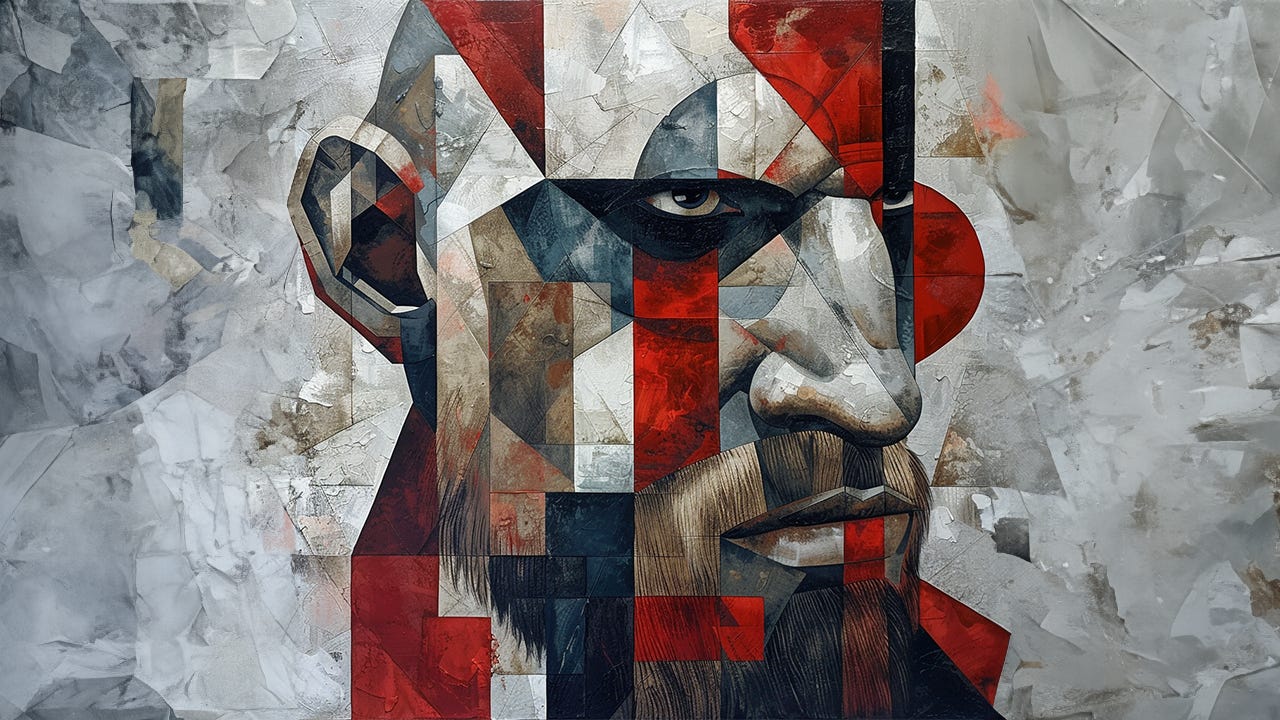
Season 3 of the Artwell podcast is available now! I studied God of War and interviewed its creators to find lessons that are relevant for modern creatives.
If this essay were written on another day, you would be reading something different. It wouldn’t be structured the same, the phrases would change, and there would be different quotes. It is not only a product of its time, but a product of the exact moment that it was created.
God of War Ragnarok director Eric Williams once said that “making a game is a magic trick that can never be repeated”. What he means is if you were to turn back time and ask the exact same group of developers to make the exact same game, they would end up making something different. Game development, as with any art form, is the sum of millions of little decisions that combine to make one output. If you had to do it over again, the odds of you coming up with the exact same answers to every single one of those millions of questions is highly unlikely.
We’re seeing this play out in real time. Taylor Swift is currently in the process of rerecording all of her albums and each new rerelease sparks the same debate, which one is better, the original or “Taylor’s Version”? While the answer comes down to individual taste, the fact that this question is being asked proves that there is a difference between each album. Even though they are the same songs, recorded by the same people, they are not the same.
The magic of the creative process is that it cannot be replicated, even by the same individual using the exact same process. With endless permutations, you’re hopeless to stumble down the same path twice. The odds of any piece of art coming into existence in the exact way it is presented to you is infinitely small… and that’s what makes it so special.
“No man ever steps in the same river twice, for it's not the same river and he's not the same man.” – Heraclitus, Greek Philosopher, 540 BC-480 BC
Without Mess, There is No Magic
Making art requires you to start with unknowns and work to figure them out. You need to know enough to get moving but not so much that you’re just playing paint by numbers. The creative process requires there to be a sense of discovery and you don’t get that if you start with all of the answers. Knowing exactly what you’re trying to make isn't creative; it's formulaic. Following a recipe is not the same thing as creating a dish.
“Figuring it out is the creative process. If there's no figuring it out, you're just executing, and a lot of times you can feel it; you can feel a game that just executed that has neat stuff in there and it looks really pretty but they just executed.” – Cory Barlog, Director, God of War, 2021
That is not to say that having a plan isn’t important. Taking the time in the beginning to set the course and be intentional about what it is that you’re trying to make matters. But by following a plan too rigidly, you close yourself off to the magic that presents itself on the day. Those magical moments are the ones you never could have imagined, or in other words, they happen when things don’t go according to plan. When the plan starts to fall apart, is when the magic starts to happen.
The most exhilarating thing for any creative is when they stumble onto a brilliant idea they hadn’t thought of. There’s no feeling in the world that compares to an aha moment. But that only happens when you get stuck, when you come up against an obstacle you hadn’t planned for and have to figure out a new way forward. Picasso once said that “Inspiration exists, but it has to find you working” because it is only by working that you make progress, and it is only by progress that you discover the next obstacle, and it is only by being stuck that you have creative breakthroughs.
"It's super easy to look back and go, ‘oh well, we should have planned better’. I don't know, tell me the best creative inspiration that was planned for." – Cory Barlog, Director, God of War, 2018
When you decide to make something you are entering into an agreement with yourself to create a bunch of problems that you have to solve. When enough of those problems add up, they make a mess. In the middle of a project is when things are at their messiest because that is when you have the most unsolved problems. While this is challenging, it is necessary, because where art is truly made is in the mess.
It is in the mess where all bets are off, where you take risks and try things you never would have had things gone according to plan. It is in the mess where happy accidents occur, you make discoveries that you never would have had things gone according to plan. It is in the mess where the magic is found, where art is made that never would have been had things gone according to plan.
"It should be messy. It should be experimentation. It should be failure. It should be aha moments that are ugly… A lot of the neatest things come from accidents." – Cory Barlog, Director, God of War, 2018
What an idea looks like in your head is never what it will look like when you bring it into existence. Your mind has no constraints, but the world is full of them. Navigating the mess is the process of wrestling with your idea until it fits within the confines of reality. Of course that gets messy, but when you finish you will have taken something imaginary and made it real… that’s magic.
Without Science, There is No Magic
Eric Williams' design philosophy is to “start with science, and finish with feel”. He knows that art has rules, rules that exist because they are tried and true, but at the same time, he understands that ‘the map is not the territory’. What you have planned for and what is real are not the same thing. The “rules of art” are a reduction of a much more complicated process. They point you in a direction and get you moving, but it is your responsibility as an artist to adapt to reality as it unfolds in front of you.
“Storytelling is equally a dark art and sort of science at the same time. There are methodologies, but a lot of it is this feel.”— Cory Barlog, Director, God of War, 2019
You cannot manufacture the mess. If you try to create it you are forcing a desired outcome which is the antithesis of spontaneity. The magic is found in the unexpected, when you are forced to deviate from your plan, not when you are in the absence of one. Having a map is not helpful if you don’t know where you’re going. When you come to an obstacle, you want to make sure your solution moves you in the right direction.
"You never set a single course and then just roll with it. There’s always something in the way. There’s always a new sort of turn you're gonna have to make, and if you're smart you can be open to it.” – Cory Barlog, Director, God of War, 2018
What any artist is trying to do is capture moments of truth, moments that make an audience fully believe in the story you’re telling. In order for something to be believable it must be anchored in what is true, and there’s nothing more real than what is in front of you. To be open to capturing the magic on the day you must not ignore what is actually happening for what you wish had happened. Agility is one of the most important skills an artist can have. In the act of creation, inspiration happens in a flash and if you’re not ready to pounce on it immediately, it passes you by.
You might not be able to plan for inspiration, but you can be prepared for it. All of the work you do in advance teaches you what to look for. It is only by knowing what it is you’re trying to make, that will allow you to know when you’ve stumbled onto something better. Without intention, you don’t know how to interpret feedback because you’ll have nothing to compare it to. You want to start with what you know (the map) but be ready to adapt as the truth presents itself to you (the territory).
“You've done the work, now you're just trusting the moment. And then you've got these brilliant actors that are also doing the same thing; that's when the electricity happens and the magic of the moment that you will never pre-plan. You just do the work you need to do to show up to meet it and receive it and reflect back.” – Danielle Bisutti, Freya, God of War, 2024
Without Risk, There is No Magic
You don’t have to make art, you choose to. It’s easy to fall into the trap of taking yourself too seriously and smothering everything you loved about creating. If you’re not careful you can get to a point where your art becomes about everything but the art itself. You lose yourself stressing over money, deadlines, opinions, and politics. It’s important to always remember why you started in the first place, to make cool things and share them with the world.
“Cool, let’s just do it one more time… why? Because we love making movies.” – Quentin Tarantino, Director, Inglourious Basterds, 2009
Of course things like budgets and deadlines matter, but if you’re given money to make something, you’re doing a disservice if you aren’t trying to make the greatest thing you can with it. Greatness is not found by playing it safe, it is found just beyond the boundary of what is known. You don’t want someone’s reaction after watching your movie to be, “that’s exactly what I expected”. The goal is to give people an incredible experience in ways they didn’t expect. There’s no magic if the audience can explain your trick.
The role of the artist is to push the culture forward, to build upon what is known and give something new. The middlemen of culture want to give you something you’re familiar with. Something that will grow bank accounts, but will keep the culture in place. Therefore, the responsibility of the risk falls on the artist. It is the artist who ventures into the unknown and takes a chance on something they believe in, and gives it to the world, whether they’re ready to receive it or not.
“The role of artists in a healthy culture is to bring to public awareness elements of being that have not yet entered the collective consciousness… Artists are right on the edge and they're expanding the landscape, they're moving the culture forward.” – Jordan Peterson, Psychologist & Author, 2017
When making God of War, director Cory Barlog had an idea: he wanted to make a game where the camera never cut. Nobody was asking him to do this, in fact, he was actively discouraged from doing it. He was warned that it had never been done before, it wasn’t practical, it might not even work, and it would definitely take more time and cost more money. Despite the fact that there were safer options available, Cory went ahead and did the “no cut camera” anyway.
This decision did not come without its hardships. The no cut camera was in fact, impractical and it definitely took more time and cost more money. It led to new obstacles in the storytelling process but that forced Cory and the team to develop creative solutions, ones that never would have happened had they had the luxury of cutting. What resulted was a special experience, one that was unlike anything that had ever been seen in video games before. Because they took this risk, a new precedent was set for what an immersive story could look and feel like.
"What do we do in games? We go, ‘we love movies and we love TV’ so we pretty much try to make movies and TV in our games. For me, starting to work with a bunch of filmmakers, I realized filmmakers are looking over at games and going, ‘oh, a frontier. I see something over here I want to get involved in’. And there's a little bit of the ego on my side of saying, ‘I don't want these filmmakers coming in and making all the breakthroughs’. We've been working on this for a while – I want us to be the ones to do the interesting things”. – Cory Barlog, Director, God of War, 2018
There’s nothing magical about doing what has already been done. It is the risk takers who find new, unforeseen obstacles that lead to creative breakthroughs and ideas no one has had before. Odds are you won’t catch lightning in a bottle if you spend your time running to where lightning just struck. If the magic happens when you venture into the unknown, you won’t find it by retracing the footsteps of those who came before you. You’ll find it by picking up where they left off and carrying on into the next frontier.
"Experts… that's a silly word to me. Why would you want an expert on your team? They know everything in the past. I want pioneers, a lot of people going into the unknown like, ‘yes, let's go do that’." – Eric Williams, Director, God of War: Ragnarok, 2023
With Great Power Comes Great Responsibility
Art done well can change how someone sees the world, it gives them a perspective they could not see on their own. Art done well helps us make sense of the world, it puts words to things we previously had no words for. Art done well brings us together, it creates a shared language that anyone, regardless of age, race, gender, background, or culture can understand. Art done well can change the world, because it can change people, who change the world.
The risk undertaken by an artist is not only whether or not their art will succeed, but what will happen if it does. Art allows you to take an idea from your head, share it with the world, and alter the trajectory of our species. If art moves the culture forward you want to make sure it’s moving it in a good direction. You have a responsibility as an artist because you are wielding a magic that has the power to change the world.
“What is it said, ‘Man does not live by bread alone’? That’s exactly right. We live by beauty, we live by literature, we live by art, and literally, not metaphorically we cannot live without it.” – Jordan Peterson, Psychologist & Author, 2017
Thanks for reading! If you haven’t already, make sure you subscribe to the newsletter for more essays that help you become a more thoughtful artist. If you want to learn more about God of War, you’ll like Season 3 of the Artwell podcast where I studied the making of the games and interviewed its creators to find lessons that are relevant for modern creatives.